Our History
Mt. Calvary Lutheran Church in Peoria is a mid-sized, family congregation rich in tradition and grounded in faith, love and hope.
Humble Beginnings
In 1931, the Walther League at Christ Church and the Central Illinois District Mission Board determined that Mt. Calvary’s neighborhood, then on the “North Side” of Peoria, would be an ideal place for a Sunday School mission. Within six months of the first classes held in a house on Gift Street, the original members of Mt. Calvary signed the congregational charter and were received into the Lutheran Church — Missouri Synod. Within a year, the congregation built a modest chapel at the corner of Broadway Street and Hanssler Place.
With guidance from the Rev. George Wittmer, they became independent of mission support from the District in 1939.
Growing in Christ
By 1940, the congregation purchased a parsonage for the new pastor and his family. By 1951, Mt. Calvary had grown to the point where they were able to build an additional section to be used as a sanctuary (today used as the fellowship hall).
Continuing the call from Christ, members established a day school in 1955 headed by Principal Walter Flachsbart. In 1959, Mt. Calvary joined with Trinity and Redeemer Lutheran Churches to build Concordia Lutheran School, a K-8 school on Glen Avenue.
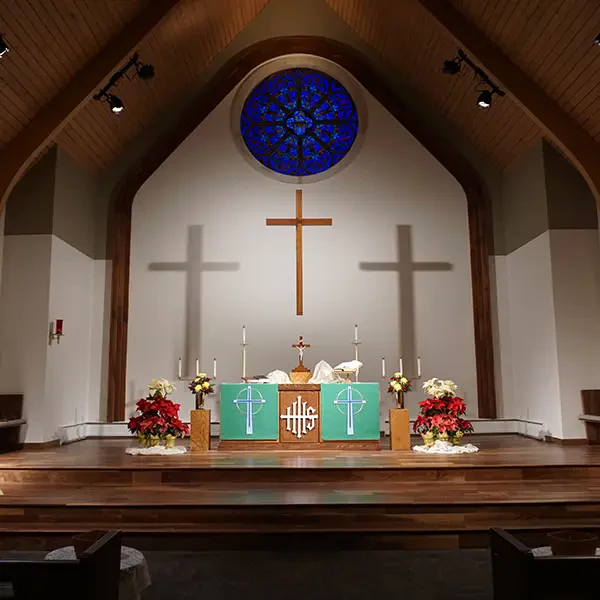
A new phase of the building was completed in 1962, which included our current sanctuary and education rooms.
Spreading God’s Word
Mt. Calvary continues to serve the growing need of Christians in our community in many ways
- Sunday school for children and adults
- Confirmation classes
- Mid-week Bible studies
- Home-based, monthly Bible study/Fellowship groups
In addition to spiritual education, Mt. Calvary celebrates Christ through music
- A men’s singing group
- Adult & children choirs
- A bell choir
- A Schantz pipe organ, dedicated in 1981
Mt. Calvary also supports our local residents by operating a food pantry open to individuals and families in need, and hosts the West Central Neighborhood Association meetings at the church.
We welcome visitors to experience the community, fellowship and acceptance that is Mt. Calvary Lutheran Church. May God bless you!
Lutheran History
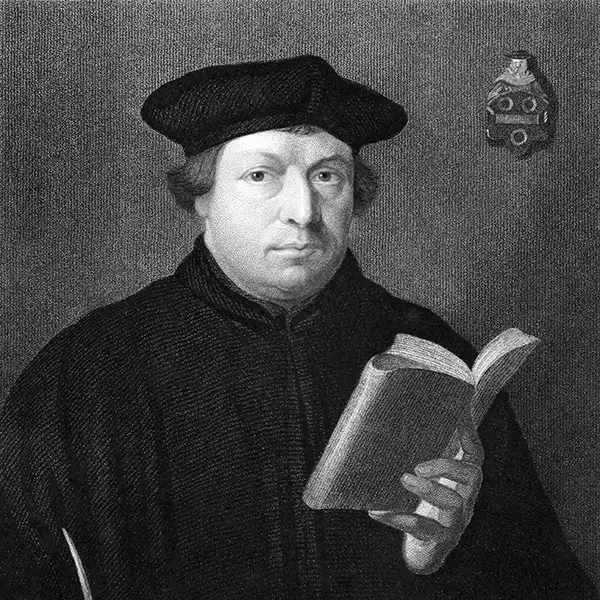
Martin Luther (born November 10, 1483, in Eisleben, Germany, died February 18, 1546 in Eisleben) is known as the instigator of the Reformation. He had studied to be a lawyer before becoming an Augustinian monk in 1505, and was ordained a priest in 1507. While continuing his studies in pursuit of a Doctor of Theology degree, he discovered significant differences between what he read in the Bible and the theology and practices of the Roman Catholic Church of his day. On October 31, 1517, he posted a challenge on the church door at Wittenberg University to debate 95 theological issues. Luther’s hope was that the Roman Catholic Church would reform its practice and preaching to be more consistent with the Word of God as contained in the Bible.
What started as an academic debate escalated to a religious controversy of cataclysmic proportions, fueled by fiery temperaments and violent language on both sides. As a result, there was not a reformation of the Roman Catholic Church but a splintering of the church into many denominations. “Lutheran” was a name applied to Luther and his followers as an insult. They adopted this name as a badge of distinction but preferred to be called "Evangelicals" in honor of the Gospel.
Lutherans still celebrate the Reformation on October 31 and still hold to the basic principles of the theology and practice espoused by Luther, such as Sola Gratia, Sola Fide and Sola Scriptura:
- We are saved by the grace of God alone — not by anything we do;
- Our salvation is through faith alone — we only need to believe that our sins are forgiven for Christ’s sake, Who died to redeem us in order to receive God's blessings and new life;
- The Bible is the only norm of doctrine and life — the only true standard by which teachings and doctrines are to be judged.
- Scriptures and worship need to be in the language of the people.
Many Lutherans still consider themselves as a reforming movement within the Catholic Church, rather than a separatist movement, and Lutherans have engaged in ecumenical dialogue with other church bodies for decades.
Luther’s Small Catechism is still used to introduce people to the Lutheran faith, as is the Augsburg Confession (the formal description of the Evangelical/Lutheran faith that was presented to the Emperor in 1530 AD). These and other Lutheran confessional documents included in the Book of Concord may be ordered from Concordia Publishing House, the publishing house of the Lutheran Church - Missouri Synod.